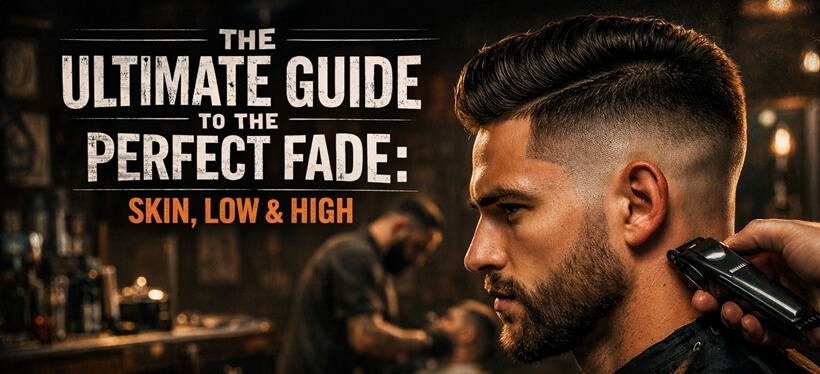
The fade is the backbone of modern men's haircutting. Ask for one at any decent barbershop and you'll be understood. But there's a massive difference between a low fade that barely brushes your ears and a skin fade that vanishes into the scalp like smoke — and knowing which you want changes everything.
In this guide, I'll break down the three main fade types we offer at Blade & Co, explain how to ask for each one, and tell you exactly how to maintain it between visits.
What Is a Fade?
A fade is a graduated reduction in hair length, typically starting at the sides and back. The hair transitions from shorter at the bottom to longer at the top — seamlessly, with no visible line between lengths.
The key word is seamlessly. A poor fade has a hard, obvious cut-off point. A great fade blends so smoothly that the transition is invisible to the naked eye. That's what separates a good barber from a great one.
"A fade isn't about how short you go — it's about how smooth the transition is. Anyone can go short. The craft is in the blend."
The Three Main Fade Types
1. Low Fade
The low fade starts just above the ears and the neckline — roughly 1–2 cm from the hairline. It's the most subtle of the three, which makes it the most versatile. It works with almost any style on top: slick backs, quiffs, natural texture, you name it.
Best for: Corporate environments, oval and round face shapes, first-time fade clients.
2. High Fade
The high fade starts much further up — typically at the temples, around 5–7 cm above the ears. It's a bolder, more defined look that creates a strong contrast between the short sides and the length on top.
Best for: Pompadours, faux hawks, textured crops. Suits oblong and diamond face shapes particularly well.
3. Skin Fade (Bald Fade)
The skin fade takes the hair all the way down to the skin at the bottom. The graduation from skin to longer hair above is the tightest and most challenging blend of all three types.
Best for: Making a statement. Pairs well with detailed designs and patterns cut into the fade. Requires the most frequent maintenance — every 2–3 weeks to stay sharp.
How to Ask for a Fade
When you sit in the chair, be specific. Here's what to tell your barber:
- Where to start: "Low" (above ear), "Mid" (at temples), "High" (above temples)
- How short: "Down to a 1", "Down to a 0.5", "Skin/bald"
- The length on top: "Leave 3 inches on top" or "Take a little off the top"
- Show a reference photo — this eliminates any ambiguity
Maintenance Between Visits
A good fade lasts 3–4 weeks before it needs a clean-up. Here's how to extend that:
- Use a light pomade or wax to keep the top styled and the fade looking intentional
- Wash your hair 2–3 times a week with a mild shampoo — over-washing strips oils
- If the neckline starts to blur, come in for a quick edge-up (usually $10–12)
And that's really all there is to it. A fade is the single best investment you can make in your everyday appearance. It elevates every other style element — clothes, beard, posture — by signalling that you pay attention to detail.
If you want to see which fade works best for your face shape, book a consultation with any of our barbers. We'll figure it out together.